
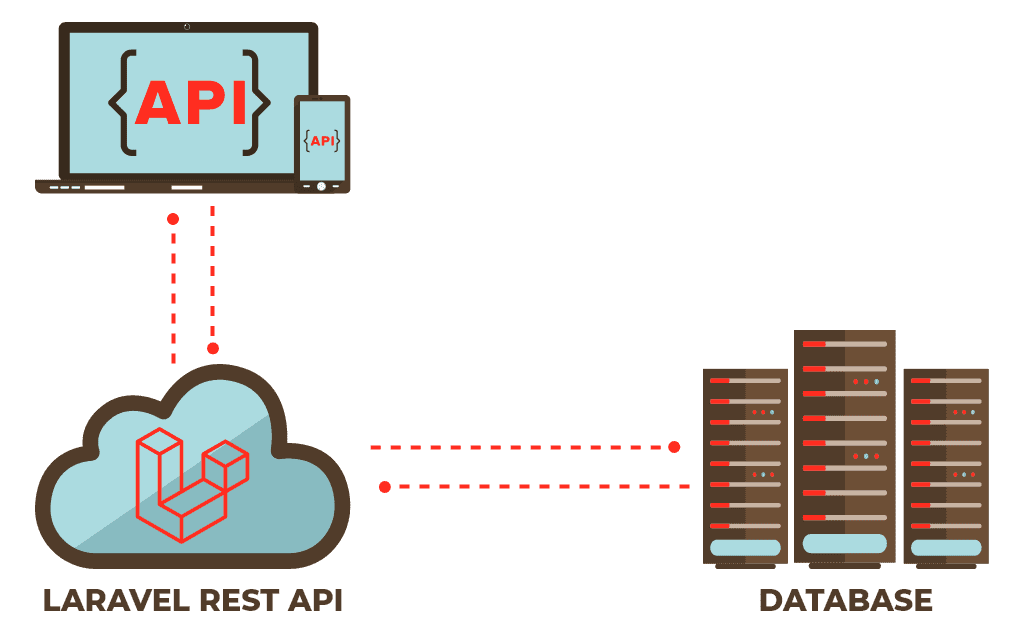
In today’s digital economy, APIs have become the backbone of software systems. Whether you’re building a minimum viable product (MVP) or a complex enterprise platform, a well-designed API architecture is critical for scalability, security, and maintainability. At Skye8, we have guided multiple projects from small Laravel MVPs into scalable, enterprise-grade API ecosystems.
This article shares our proven blueprint to help you design, build, and maintain robust Laravel APIs that grow with your business.
1. Start with API-First Design
An API-first mindset means designing your backend as a service from the beginning — regardless of whether you have frontend apps, mobile clients, or third-party integrations.
Using Laravel’s Sanctum or Passport, secure your APIs with token-based authentication that is flexible and scalable.
# Install Laravel Sanctum
composer require laravel/sanctum

# Publish Sanctum configuration and migrations
php artisan vendor:publish --provider="Laravel\Sanctum\SanctumServiceProvider"
php artisan migrate
Use middleware to protect routes:
Route::middleware('auth:sanctum')->get('/user', function (Request $request) {
    return $request->user();
});
2. Implement Versioning for Stability
API versioning allows you to evolve your API without breaking existing clients. At Skye8, we use URI versioning for clarity:
Route::prefix('api/v1')->group(function () {
    Route::get('products', [ProductController::class, 'index']);
});

Route::prefix('api/v2')->group(function () {
    Route::get('products', [ProductV2Controller::class, 'index']);
});
This allows new features to be added in v2 while v1 remains stable for legacy clients.
3. Automate API Documentation
Maintaining up-to-date API documentation is critical, especially for enterprise clients and partner integrations.
We use Swagger/OpenAPI tools such as L5-Swagger to generate interactive API docs automatically from annotations.
Example annotation:
/**
 * @OA\Get(
 *     path="/api/v1/products",
 *     summary="List all products",
 *     @OA\Response(response=200, description="Successful operation")
 * )
 */
public function index()
{
    return Product::all();
}
The result: always accurate, developer-friendly documentation that reduces onboarding time and support load.
4. Centralize Error Handling and Logging
Consistent error responses improve client experience and debugging efficiency. Laravel’s exception handler (app/Exceptions/Handler.php) can be customized to return JSON-formatted errors for API routes.
Example:
public function render($request, Throwable $exception)
{
    if ($request->expectsJson()) {
        return response()->json([
            'error' => $exception->getMessage(),
            'code' => $exception->getCode() ?: 400
        ], 400);
    }

    return parent::render($request, $exception);
}
We integrate Sentry or Laravel Telescope in staging to monitor exceptions and log API performance metrics.
5. Secure Your APIs
Security is paramount. Besides authentication, we apply:
-
Rate limiting to prevent abuse:
Route::middleware('throttle:60,1')->group(function () {
    Route::get('/data', 'DataController@index');
});
-
Input validation using Laravel’s Form Requests to sanitize and validate data.
-
Use HTTPS exclusively to encrypt traffic.
6. Design APIs for Scalability and Maintainability
-
Use Resource Collections and API Resources for consistent response formats.
-
Separate business logic into Services or Actions to keep controllers lean.
-
Use Repository Pattern if data source abstraction is required.
Example API Resource:
use Illuminate\Http\Resources\Json\JsonResource;

class ProductResource extends JsonResource
{
    public function toArray($request)
    {
        return [
            'id' => $this->id,
            'name' => $this->name,
            'price' => $this->price,
            // more fields
        ];
    }
}
Final Thoughts
Building an API that can evolve from MVP to enterprise scale requires deliberate design and adherence to best practices. At Skye8, we believe in combining Laravel’s elegance with solid architecture principles to deliver APIs that stand the test of time and traffic.
Start with security and versioning, automate your documentation, and never compromise on error handling or performance. These steps will make your APIs a trusted pillar for your entire ecosystem.
Comments (0)
Leave a Comment
Be the first to comment on this article!